 Neural Neeraj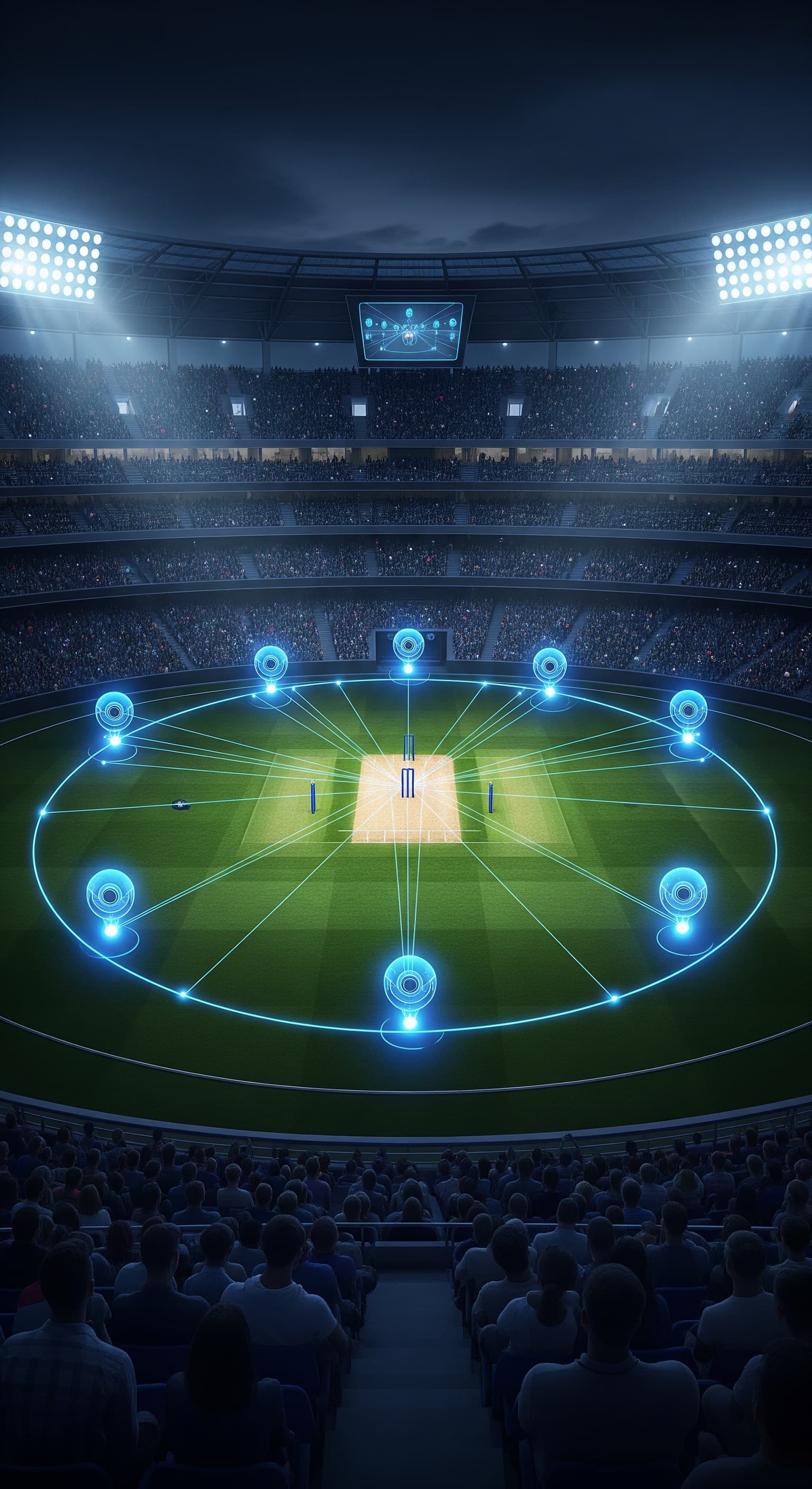
The Tech Behind IPL's DRS — 3.6mm Accuracy
Only 28.5% of DRS Reviews Actually Overturn the Call
That number should recalibrate how you think about Hawk-Eye. The system's job isn't to prove umpires wrong -- it's to provide a ±3.6mm certainty envelope around a 72mm ball traveling at 150 km/h. Three out of four reviews confirm the on-field decision. The technology is a safety net, not a replacement.
8 Cameras at 300+ FPS
Hawk-Eye deploys 8 high-speed cameras around the ground, each capturing at 300+ frames per second. At 150 km/h, a cricket ball moves roughly 14cm between frames. With 8 simultaneous viewpoints, the system triangulates a 3D position for every frame, producing a trajectory reconstruction with ±3.6mm average error -- less than the width of two stacked credit cards.
Pre-match calibration maps each camera's 2D image plane to 3D world coordinates using known reference points on the pitch. This calibration drifts during the match as temperature shifts cause camera housings to expand by fractions of a millimeter. The system auto-corrects continuously, with human technicians monitoring for drift the broadcast never shows you.
The Physics Simulation Nobody Talks About
Camera data tells you where the ball was. The hard part is predicting where it would have gone after the pad intercept. Hawk-Eye runs a physics engine modeling:
- Gravity at 9.81 m/s²
- Air resistance -- drag coefficient varies with ball condition, altitude, and humidity
- Seam and spin deviation -- lateral movement after pitching, extrapolated from pre-pitch trajectory data
- Pitch surface interaction -- bounce coefficient calibrated to the specific pitch
The projection through the stumps zone is where ±3.6mm becomes load-bearing. The stumps are 228mm wide. When the projected path clips leg stump by 5mm, the system's error margin is the difference between "out" and "umpire's call." This is exactly why the ICC introduced the umpire's call threshold -- when less than half the ball is hitting the stumps, the uncertainty means the on-field decision stands.
Smart Replay System and IPL 2025 Wides Detection
IPL 2024 introduced the Smart Replay System -- automated camera angle selection and faster ball-tracking renders that cut the review cycle time significantly. No more waiting while the TV director hunts for the right replay angle.
IPL 2025 pushed the envelope further with wides detection. The system now tracks deliveries outside off-stump and above head-height, expanding the zone of reviewable decisions beyond the traditional LBW and edge-detection scope.
Google Gemini: ₹270 Crore for AI-Augmented Cricket
The biggest tech deal in IPL history landed in 2026: Google's ₹270 Cr partnership (2026-2028) integrating Gemini AI Mode into broadcasts. This layers AI-powered analysis on top of Hawk-Eye's tracking data -- predictive insights, historical pattern matching, real-time tactical breakdowns.
Think of it as a second inference layer. Hawk-Eye produces the tracking data (computer vision). Gemini consumes that data and generates contextual analysis (language model). Two AI systems, complementary architectures, one broadcast pipeline.
The Infrastructure Stack
Each Hawk-Eye installation runs on dedicated fiber-optic connections between cameras and GPU processing units. A full computation -- 8 camera feeds to 3D trajectory to stump-line projection -- completes in under 3 seconds. The same core technology powers line-calling in tennis (where it eliminated human line judges entirely at the Australian Open), goal-line tech in football, and trajectory analysis in baseball.
The real engineering achievement isn't the ±3.6mm number. It's that this system runs reliably across dozens of venues, varying weather conditions, and different pitch surfaces, producing consistent results that 1.5 billion cricket fans trust enough to scream at when the decision goes against their team.
The open question: as Gemini's AI layer starts generating predictive analysis mid-over, how long before we see an AI-recommended DRS prompt -- the system telling the captain when to review?